 AuDHD, HonestlyMark Chapters
AuDHD, Honestly: A Guide for Adults with Autism and ADHD
A guide for adults with autism and ADHD
What's really going on, what to try, and how to get through the bad days.
By Mark Chapters
What is AuDHD?
Last reviewed
AuDHD is a community word for being autistic and having ADHD at the same time. It isn't a diagnosis in itself. The diagnoses are autism and ADHD, and since 2013 a clinician can diagnose both in the same person. People with both often describe two sets of needs pulling against each other: one side asking for predictability and quiet, the other for novelty and stimulation.
- Common together. In a review that pooled dozens of studies, about 28% of autistic people also had an ADHD diagnosis.
- Each can hide the other. That's why many adults find the second one years after the first.
- The two sides interact. Advice built for one side often runs over the other, which is what this book is about.
- No single test. Autism and ADHD are each assessed by a clinician, and one assessment can look at both.
Who it's for
For
- Adults who are autistic and ADHD, or think they might be, whether you found out last week or decades ago.
- Anyone who has read an explainer and still doesn't know what to do on a bad Tuesday.
- Partners and parents of adults with both. There's a section written for you.
Not for
- Children and teens. It's written for adults.
- Getting a diagnosis. It helps you prepare for an assessment, and it isn't one.
- Crisis care. If you're not safe right now, start with the help line at the bottom of this page.
Which side of me is asking for this?
The one question the book teaches. Your autistic side often asks for less: predictability, quiet, clarity, time to recover. Your ADHD side often asks for more: interest, novelty, movement, a reason to start. When the answer is both, every chapter has tools built for that exact clash.
This is the Needs Map from chapter 2. Cross out what isn't you. Add what is. Contradictions are fine. You have both.
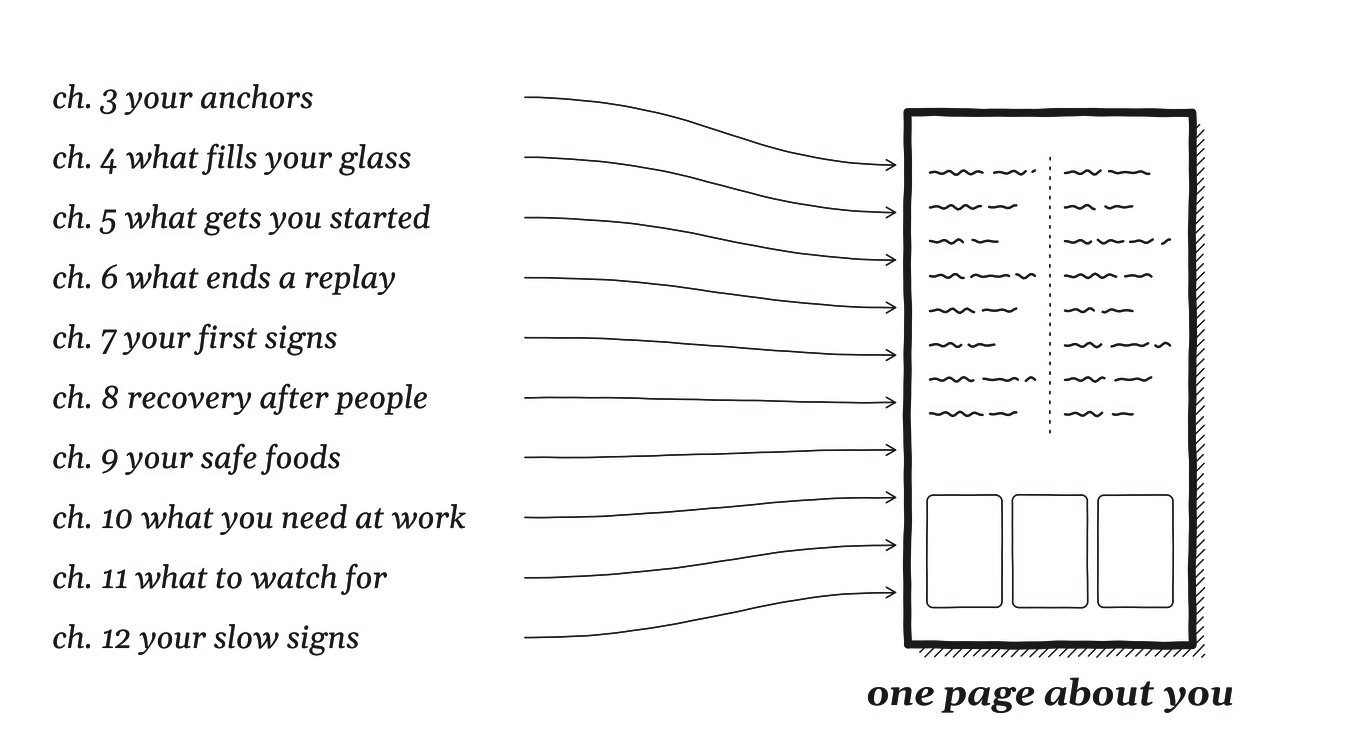
By the last page, you have a page about you
It starts in chapter 2 as these two short lists. Every chapter adds a line: your first signs, your slow signs, your bad-day kit. Chapter 13 turns it into one page you can keep, hand to a partner, or take to a doctor.
Why this book
You need a routine on Monday and can't stand it by Thursday. A sound you didn't notice yesterday has your jaw clenched today. Advice written for autism ignores your ADHD side, and advice written for ADHD runs over the autistic one.
Most books about autism and ADHD either explain you well and leave you there, or hand you a system that assumes a good day. This one does both halves, honestly.
What's really going on
Both sides in plain words, a few pages a chapter. Every claim carries a mark that shows who it was studied in.
What to try
44 tools, offered as options rather than orders. Each one says when it fits and how to do it.
How to get through the bad days
Every tool has an "on a bad day" version. Every chapter opens with a two-minute version, for days when a whole chapter is too much.
AuDHD vs ADHD vs autism
What people with each tend to describe, side by side. These are tendencies, not a checklist. Plenty of people with one diagnosis recognize lines in both columns, and only an assessment can sort that out.
| Autism | ADHD | AuDHD, both together | |
|---|---|---|---|
| Routine | Predictability helps. Change costs energy, even good change. | Sameness gets boring fast. Novelty is what gets things moving. | Needing a routine on Monday and not standing it by Thursday. Routines last when they have a fixed anchor and a part that's allowed to change. Chapter 3 |
| Sensory input | Noise, light and crowds can quickly become too much. | Often seeks more: sound, movement, something to do with your hands. | Seeking and avoiding input in the same person. The same noise lands differently on different days. Chapter 4 |
| Starting and stopping | Inertia: hard to start, and hard to stop once going, because stopping is a change too. | Hard to start what isn't interesting or urgent. Hard to look away from what is. | Both kinds of stuck in one person, so a task can stall at the start, in the middle, or at the switch to the next thing. Chapter 5 |
| Rejection | The replay: going over what was said, for hours, often that night. | The sting: fast, big and instant. Feelings that hit fast are well documented in adult ADHD. | Rejection hits twice: the sting at the door, then the replay that night. Each part needs a different tool. Chapter 6 |
| People | Time with people, even good time, costs energy and needs recovery afterward. | Often wants people, talk, plans and something new. | The yes on Saturday, the bill on Sunday. One side says yes to people and plans, and the other pays later. Chapter 2 Chapter 8 |
| When it's too much | Meltdowns or shutdowns when input builds past what you can hold. | Strong feelings that arrive fast and take a while to settle. | The fast reaction and the slow overload in the same evening, and feelings that sometimes arrive days late. Chapter 7 |
| Burnout | Worn down by input, people and masking. | Worn down by years of pushing across the gap between wanting to and doing. | Burnout from both directions at once, and the two causes need opposite fixes. Chapter 12 |
Each row is a chapter of the book, where every claim is marked by who it was studied in. Many of these patterns are what adults with both describe, and haven't been studied in people with both yet.
Every chapter works the same way
The same layout every time, so you always know where you are. A fresh scene at the start of each one, so it never feels like the last.
Honest about what's known
Very little research looks at adults with both. So every claim and every tool says whose evidence it rests on.
- Both
- Studied in people with autism and ADHD.
- A
- Studied in autistic people.
- D
- Studied in people with ADHD.
- Lived
- Reported by many AuDHD adults, and not yet studied.
Built from 400+ reader reviews of the other books on this shelf, 562 accounts from 71 threads where adults with both talk to each other, and 46 studies, reviews and guidelines, each listed by chapter with the date it was checked.
Where the research is thin, the book says so, rather than borrowing certainty from a study of someone else. Each tool also says whether it's low risk to try or worth checking with a clinician first.
What it won't do. It won't diagnose you, and it won't tell you whether to take any medication. It will help you walk into those conversations knowing what to ask.
What readers say about Mark's other books
No reviews for this one yet. These are readers of his other books.
Strongly recommend
I didn’t appreciate just how burned out I was until I read this book. Not the everyday “tired” kind, but the deep, foggy, everything-is-too-much exhaustion that doesn’t go away with sleep. This workbook put words to experiences I’ve had for years and never fully understood.
What stood out to me is how practical and compassionate it is. It doesn’t try to motivate you, fix you, or push you to “try harder.” Instead, it slows everything down and meets you where you actually are. The idea of treating energy like a budget was especially helpful. It made burnout feel understandable instead of like a personal failure.
concrete and functional
This trio of books are the most concrete, actionable books on how to ‘be’ successfully as an autistic person. I found these a little late but all the things that worked…were in this trio of books, and reading gave me more tips. I started with the burnout book, and am halfway through the attachment one and just finished this one. Gloves. Music. And a list so I don’t forget anything. Read these. Put them into practice when you can, and you CAN.
Fantastic Read!!!
At long last, a book about keeping a home functional that doesn’t assume everyone’s brain works the same way. The Neuro-mechanics Guide to Home Maintenance provides practical tools, humor, and zero-shame approach make everyday tasks feel much more manageable. I especially appreciated the ideas around breaking tasks down, saving your progress, and working with your energy rather than fighting against it. If traditional organization advice has never quite worked for you, this book is absolutely worth a look. Highly recommended!
Fresh start
I feel like this author actual understands, and cares about their readers. I can't remember the last time I felt this when reading a book. I was shocked by the pages instructing you to get your finances together, because this one of the big areas that have serious immediate repercussions in your life. Yes, it is mostly about getting your mind around a new way of understanding yourself, and is full of guidance and help. Get it!
clear, readable instructions and explanations
All of these manuals are well done and helpful. It is funny to me that I recognize the best tools and relationships from my life in the exercises and examples, but I had not been able to explain previously why something was helpful or like being stabbed in the eyeballs. Read it. Step away. Come back and introduce the tools as you need or can.
This Author Gets Us!
In this book you are given the validation of being seen and heard just as you are without labels like lazy or just not trying hard enough. Rather than getting dense rectangles of text and exercises requiring essays , there are lots of bullet points and check lists.
What really resonated for me was the concept of energy credits with a long list of specific things I could do to feel more restored. I could check off boxes for handy reference to find again quickly. Some things I thought were just me being weird, like sometimes reading the same books, watching the same movies, eating the same foods, listening to the same music. I never realized how much of a comfort these things could be, and how much I was sometimes having to work to try new things when I was with other people, so they wouldn’t roll their eyes at me.
Modules mean you can go to whatever section you need right now, without feeling like you need to zoom through the book. If the term Autistic Burnout makes you internally scream “Yes, yes, that’s me, please help!” this book can help you and hopefully build a way to never feel autistic burnout again.
A great read for anyone that struggles being on the spectrum
As someone who was diagnosed with high functioning autism in my 40s, this is compassionate and genuinely practical guide for anyone experiencing autistic burnout. The Autistic Burnout Recovery System doesn’t offer unrealistic “just try harder” advice .. instead, it provides a thoughtful framework for understanding why burnout happens and how to recover without shame or self-blame.
What makes this book stand out is its focus on energy management, nervous system regulation, and life redesign rather than quick fixes. The steps feel achievable, and the tone is validating and respectful of autistic lived experience.
Very practical
I am not autistic but reading this has helped me to understand my daughter better. I haven't gotten all the way through it yet but this workbook seems to be extremely practical. With questions to help you understand yourself better, explanations of how the nervous system reacts, and ways of calming it. The book also discusses the energy debt and ways to counteract that. A very helpful resource.
Someone that gets it
This workbook explains burnout in a way that makes total sense without being patronising. The energy budget concept really clicked for me and the practical exercises are manageable even when you’re struggling. Feels validating to read something that understands what it’s actually like. Highly recommend for anyone dealing with burnout.
Paperback and Kindle
Get it on Amazon (AuDHD, Honestly)45 free AuDHD worksheets, ready to print
One for every tool in the book, numbered by chapter, so worksheet 6.2 goes with the second tool in chapter 6. No sign-up. Print the whole kit once, then reprint single sheets whenever you need a fresh one.
The complete kit
A cover, a contents page, and all 45 worksheets. PDF, 48 pages, 1.3 MB.
No sheet matches that. Try a number like 6.2, or a word like replay.
Chapter 1Is It AuDHD, or Just ADHD, or Just Autism?3 sheets
Chapter 2Which Side Is Asking?3 sheets
Chapter 3Craving Structure, Breaking It3 sheets
Chapter 4Loud Today, Fine Yesterday4 sheets
Chapter 5No Follow-Through Button, No Off Switch4 sheets
Chapter 6Rejection Hits Twice4 sheets
Chapter 7When It Boils Over or Shuts Down5 sheets
Chapter 8Small Enough, but Not Invisible3 sheets
Chapter 9Home on Low Battery3 sheets
Chapter 10Work, and Getting Work4 sheets
Chapter 11Medication, Sleep, and What Else Travels with AuDHD3 sheets
Chapter 12Burnout, from Both Sides3 sheets
Chapter 13Your AuDHD Page3 sheets
Reading on Kindle? The ebook has every worksheet in text form, inside its chapter. These are the printable versions. The paperback has all 45 printed in.
AuDHD words, in plain language
The words you'll meet in AuDHD spaces, defined the way the book uses them. Several, like masking, meltdown and body doubling, come from the people who live with them. Tap a word to read it.
- Difficulty knowing and naming what you feel. Common in autistic people. Chapter 7
- Long-lasting exhaustion, loss of skills you usually have, and lower tolerance for input, as autistic adults describe it. Chapter 12
- Doing a task with someone simply there, without them helping with it. That person is the body double. Chapter 5
- The idea that communication between autistic and non-autistic people can break down on both sides, not only one. Chapter 8
- Trouble with the mental skills that plan a task, start it, keep it going, finish it and switch to the next. Chapter 5
- Being held so completely by something interesting that time disappears. Chapter 5
- Difficulty acting on what you intend to do, starting or stopping. Often called autistic inertia. Chapter 5
- Sharing everything you know about something you love. For many people, a way of showing love.
- The sense that tells you what's going on inside your body: hunger, thirst, tiredness, needing the bathroom. Chapter 4 Chapter 11
- Hiding or adjusting the ways you're different, so you'll fit in. Researchers call it camouflaging. Chapter 8
- An overload that comes out: crying, shouting, leaving, losing control of the moment. Chapter 7
- An idea from autistic writers: attention that goes deep into one thing at a time. Chapter 5
- Rejection sensitive dysphoria. A community term for the sudden, intense sting of rejection. Not a diagnosis. Chapter 6
- A food you can nearly always eat, whatever the day is like. Chapter 9
- When sound, light, touch, smell or crowds add up to more than you can take in. The same noise can be fine one day and too much the next. Chapter 4
- An overload that goes inward: going quiet, losing words, needing to be left alone. Chapter 7
- A deep, lasting interest that often feeds both sides at once.
- Repetitive movement or sound that helps regulate: rocking, tapping, humming, fidgeting. Chapter 4
The book's own words
- The book's one question. Is this need coming from your autistic side, your ADHD side, or both? Chapter 2
- Two lists, autistic side and ADHD side, that grow chapter by chapter into one page about you. Chapter 2 Chapter 13
- One side says yes, and the other side pays later. Chapter 2
- How much input has already built up today. The same noise is one drop on an empty glass and the last drop on a full one. Chapter 4
- The fast, big hurt of rejection in the moment, then going over it again and again afterward, looking for what went wrong. Chapter 6
- Judging how you're doing by the trend over weeks, not by one bad day. Chapter 12
AuDHD questions, answered
The questions people search most about AuDHD, answered plainly, then the ones readers ask about the book.
About AuDHD
What does AuDHD mean?
AuDHD means being autistic and having ADHD at the same time. The word joins the two, Au for autism and DHD for ADHD. It was made by the community, not by a diagnostic manual, and many people use it because neither label on its own describes how the two sides pull against each other.
Is AuDHD a real diagnosis?
Not as a single diagnosis. AuDHD is a community word. The diagnoses are autism and ADHD, and a clinician can diagnose both in the same person. What people describe under the word is real, and you don't need a formal diagnosis to use the tools in this book.
Can you be diagnosed with autism and ADHD at the same time?
Yes. Since the DSM-5 in 2013, clinicians can diagnose both. For almost two decades before that, the manual many of them work from didn't allow ADHD to be diagnosed alongside autism, which is part of why so many adults found out late. Having both is common. In a review that pooled dozens of studies, about 28% of autistic people also had an ADHD diagnosis, and a guideline paper from one specialist autism clinic quotes estimates of 40 to 70%, depending on the study.
What's the difference between AuDHD and ADHD?
ADHD on its own and AuDHD share the ADHD side: trouble starting what isn't interesting, a pull toward novelty, feelings that hit fast. With AuDHD, an autistic side sits alongside it and often asks for the opposite: predictability, less input, time to recover. That clash is what adults with both describe most, and it's why advice written for ADHD alone often doesn't hold. The comparison on this page sets the differences side by side.
What are the signs of AuDHD in adults?
There's no official list of AuDHD symptoms, because AuDHD isn't a diagnosis on its own. What adults with both describe most is a push and pull: needing a routine and getting bored of it, seeking noise and then being overwhelmed by it, saying yes to plans and paying for it after. Many also describe one side hiding the other for years. Chapter 1 sorts these patterns into two columns and a middle.
Is there a test for AuDHD?
There's no single AuDHD test. Autism and ADHD are each assessed by a qualified clinician, and one assessment can look at both. Online quizzes can't diagnose either. If you're wondering whether it's you, worksheet 1.1, the two-column pattern check, and worksheet 1.2, the hiding questions, help you put what you notice on paper and take real examples to an assessment. Both are free on this page.
What does AuDHD look like in women?
This book is for adults of any gender, and most of what it covers applies to everyone. What often differs for women is how long it takes to be seen. In a study of 1,211 autistic adults, women reported earlier diagnoses of personality, anxiety and mood conditions, ones they now see as mistaken, more often than men did. And among children and teens diagnosed with ADHD first, autism was diagnosed later in girls than in boys, 2.6 years later against 1.5 on average. A rule-following girl who holds it together at school is easy to miss.
What is rejection sensitive dysphoria, and how does it show up with AuDHD?
Rejection sensitive dysphoria, or RSD, is a community term for an intense, fast emotional reaction to rejection or criticism, real or perceived. It isn't a diagnosis, and the research on it is still thin, so you won't find a percentage for it here. What is well documented is that feelings come fast and land hard in adult ADHD. With AuDHD, people often describe rejection hitting twice: the sting in the moment, then a replay that runs that night. Chapter 6 has a tool for each part.
What is executive dysfunction, and how is it different with AuDHD?
Executive dysfunction means trouble with the mental skills that plan a task, start it, keep it going, finish it and switch to the next. In ADHD it often shows as not being able to start what isn't interesting or urgent. Autistic people describe a related experience called inertia, where stopping can be as hard as starting, because stopping is a change too. With both, a task can stall in more places. Chapter 5 helps you find where yours stops, and Find Your Bottleneck goes further on the ADHD side.
What's the difference between a meltdown and a shutdown?
A meltdown is overload coming out: crying, shouting, slamming a door, leaving the room. A shutdown is overload going in: going quiet, losing words, wanting to be left alone. Both are what an overloaded nervous system does, not a choice, and the same person can have both on different days. People with both often do. Chapter 7 covers your first signs and what each one needs, before and after.
What is AuDHD burnout?
It isn't a formal term, but adults with both often describe burnout that comes from two directions at once. The autistic side is worn down by input, people and masking. The ADHD side is worn down by years of pushing across the gap between wanting to and doing. The two need opposite fixes: a quiet week alone can help the first and starve the second. Chapter 12 helps you see it coming weeks ahead and sort which side is paying. There are free pages on autistic burnout and ADHD burnout too.
Can ADHD medication make autistic traits more noticeable?
Some people with both describe exactly that. The ADHD is treated, focus improves, and the overload, the need for sameness or the tiredness after people stands out more than before. Others notice no change on the autistic side at all. Medication treats the ADHD, not the autism, so this doesn't mean it failed. It's worth tracking and raising with your prescriber. This book never tells you whether to start or stop anything.
Does AuDHD get worse with age?
Many adults describe it feeling harder as they get older, and some notice it most in the years around menopause. What they usually describe is less a change in the traits than in the cost of holding them down, as life fills up and the margin gets smaller. Many also notice more after a diagnosis, once they stop covering for it, and say it eases with time. If something is changing quickly, take it to a doctor.
About the book
Do I need a diagnosis to read it?
No. Chapter 1 is built around the question most people start with: is it AuDHD, or just ADHD, or just autism? It helps you see the patterns and prepare for an assessment if you want one. Self-identification is respected throughout.
Do I have to read it in order?
No. Start Here sends you one of three ways: the two-minute versions if today is a hard day, Part One if you're new to this, or straight to the chapter that's hardest for you right now.
Does it tell me what medication to take?
No. Chapter 11 explains how the medication decision works for people with both, what people report, and what to ask, so you can walk into the appointment prepared. It contains no doses, no brand names and no advice to start or stop anything. That decision belongs to you and a prescriber who knows you.
Is this AuDHD book for adults or for children?
Adults, of any age and any gender. If you're looking for help with a child, this isn't the right book.
What's the difference between the paperback and the Kindle edition?
The text is the same. The paperback has all 45 worksheets printed in, ready to write on. The Kindle edition has every worksheet in text form, and the printable versions are free on this page.
Are there free AuDHD worksheets?
Yes. All 45 worksheets from the book are free on this page, as single PDFs or one 48-page kit, with no email sign-up. They're sized to print on A4 and US Letter.
Who wrote it, and what is it based on?
Mark Chapters, who isn't a doctor or a researcher and says so. It's built from reader reviews of the other books on this shelf, accounts adults with both share in public, and 46 studies, reviews and guidelines. Every claim is marked by who it was studied in, and the book says plainly that no clinician has reviewed it.
Sources on this page7 studies
- Lai et al., 2019, The Lancet Psychiatry. How often other conditions come with autism, including about 28% with diagnosed ADHD.
- Manter et al., 2025, BMC Medicine. A guideline paper from one specialist autism clinic: the 40 to 70% range, and the rule the DSM-5 removed.
- Antshel, Zhang-James and Wagner, 2016, Expert Review of Neurotherapeutics. Diagnosing autism and ADHD together since the DSM-5.
- Kentrou et al., 2024, eClinicalMedicine. Earlier diagnoses that 1,211 autistic adults now see as mistaken, by gender.
- Kentrou et al., 2019, Autism. A later autism diagnosis after ADHD came first, and later still in girls.
- Beheshti, Chavanon and Christiansen, 2020, BMC Psychiatry. Emotional dysregulation in adults with ADHD, across 13 studies.
- Buckle et al., 2021, Frontiers in Psychology. Autistic inertia, described by 32 autistic adults.
The book lists all 46 of its sources by chapter, with the date each was checked. Where the research is thin, this page says so rather than borrowing a number.

About the author
Mark Chapters writes practical books for neurodivergent adults, made for the reader rather than written at or about them. He isn’t a doctor or a researcher. He’s the person in the middle, who reads the studies and the accounts people share in public, and says so where they disagree.
How this book was made
For this book, that meant reading what readers said the other books on this shelf kept missing, then a great many accounts from adults with autism and ADHD, then the studies, and keeping every source listed by chapter with the date it was checked.
Nobody clinical has reviewed the book, and it says so on its first pages. It contains no story about his own life, and it won't tell you whether to take any medication. It's written for neurodivergent people, not at or about them, the same rule his best-seller, The Autistic Burnout Recovery System, was built on.
Where to go next
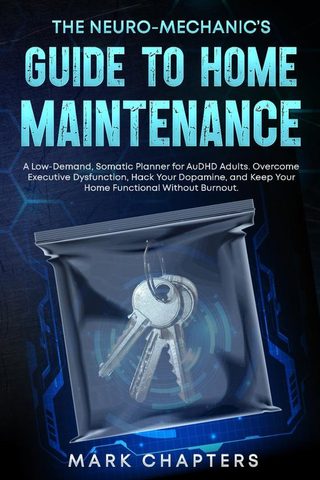
The Neuro-Mechanic's Guide to Home Maintenance
4.636 ratings
Picks up from chapter 9, Home on Low Battery
Which edition?
The Autistic Burnout Recovery System. Each link opens Amazon in your country.
Which edition?
The ADHD Burnout Recovery System. Each link opens Amazon in your country.