The complete kit, ten pages
Everything, in one file
All four instruments and the appointment sheet. Print the whole thing once, then reprint single sheets as you need them.
DownloadPDF, 392 KB Everything, in one file The ADHD Burnout Recovery SystemMark Chapters
The ADHD Burnout Recovery System
Exhaustion that rest doesn't fix. A task that takes eleven minutes, and you've been sitting in front of it since one. It isn't laziness, it isn't only depression, and resting alone won't fix it, because the problem was never how much you have left. It's what everything costs.
4.4 out of 5, 5 ratings on Amazon
If you need help nowADHD burnout is a collapse of capacity that outlasts rest, described by a very large number of adults with ADHD in almost identical terms. It is not a formal diagnosis and it is not in the DSM-5-TR or ICD-11. It differs from depression, from autistic burnout and from ordinary work burnout, and rest alone usually doesn't fix it, because the problem is closer to cost than to an empty tank.
You've been told it would take a few weeks.
This has a name. It isn't in any diagnostic manual, and the people living it named it themselves.
Not a diagnosis. A pattern.
ADHD burnout is not in the DSM-5-TR or ICD-11, and unlike autistic burnout, almost no dedicated research exists on it at all. What exists is the pattern itself: a collapse of capacity that outlasts rest, described by a very large number of adults with ADHD in almost identical terms.
The one study that comes close interviewed twenty working adults with ADHD. Several described being weathered by years of stressful work and repeated relapses of exhaustion. Some compensated by being exceedingly thorough or working extra hours, which drained them further.
That's close to the whole of the evidence. The book says so on page one, and builds on it honestly.
Oscarsson M, Nelson M, Rozental A, Ginsberg Y, Carlbring P, Jönsson F. Stress and work-related mental illness among working adults with ADHD: a qualitative study. BMC Psychiatry 22, 751 (2022). doi.org/10.1186/s12888-022-04409-w
The pattern repeats at every scale, which is the clue that something structural is driving it. A day that runs at two hundred percent by morning and two percent by evening. A job you are excellent at for three months and out of within the year. The same year happening ten times.
The book argues the crash is not the event. The crash is the bill. The good stretch is the purchase, and it is invisible while you are inside it, because it feels like finally being yourself.
Holding a face in place, rehearsing a sentence before saying it, running a background check on whether you are being normal enough. None of it is on anybody's list of tasks, it has no output and no end, and it is the first thing to go when the resource runs out. Other people rarely read that as exhaustion. They read it as a personality change.
A large share of the accounts this book is built on come from women, and so does the one verified study behind it. The likeliest reason is not a different condition but a longer runway: decades of compensating before anybody named it, and a set of medical mimics that get attributed to stress instead. That is a pattern, not a rule, and it is not confined to women. The inattentive reader of any sex has low energy rather than surplus, and the book never assumes one presentation.
Six things it gets mistaken for, and what separates them.
Part One of the book works through these one at a time. Three of them need a doctor rather than a book, and the book says which.
The World Health Organization defines burnout as specifically occupational, and says the term should not be used for other areas of life. So the question is location, not severity. If yours reached the shower, the friendships and the hobby, and did not lift when you took the time off, the word you have been using was borrowed.
Nobody separates these cleanly, including the researchers. A 2015 review in Clinical Psychology Review called the distinction conceptually fragile. The honest instruction is to get assessed rather than work it out from a table, because depression is treatable and treated well by people who do it all day.
Different loads. The ADHD side is executive: starting, switching, remembering, managing how you feel about a task while doing it. The autistic side is sensory and social, and the cost of masking. The recoveries pull against each other, and many late-diagnosed adults have both. If that sounds more like you, read about autistic burnout instead, where the research is considerably better than it is here.
The one where guessing wrong does real damage. It turns on four consecutive days or more of elevated or irritable mood, a reduced need for sleep rather than an inability to sleep, a change other people noticed, and mood episodes in your family. If any of that lands, that is an assessment before anything else, and a conversation with whoever prescribes for you.
One feature separates it, and it is easy to miss because it does not arrive on the day. Crashes that land a day or two after the effort, wildly out of proportion to what you did, taking far too long to clear. Cognitive effort counts as exertion. If that is the pattern, the activity guidance for you is specific, and getting it wrong causes harm.
The only one you can test without a referral. Not whether this is worse than other people's normal. Whether it is worse than your normal. If the answer is no, the useful appointment may be a diagnostic or medication review rather than a recovery plan.
You're not running low. Everything costs you more.
Everyone is working from the same model, including you. Tired means depleted, depleted means the tank is low, so rest. And you've tested it. You took the time off, and it came back the moment you did.
Because this was never a tank. It's a budget. Starting something, switching, holding attention on it, remembering it exists, managing how you feel about it: every one of those costs you more than it costs the person next to you. An ordinary week runs over budget without anything going wrong. Rest refills the account. It doesn't change a single price.
So the system in this book doesn't ask how you feel today. It asks you to set a number on a day you're thinking clearly, and then hold it, whatever today says.
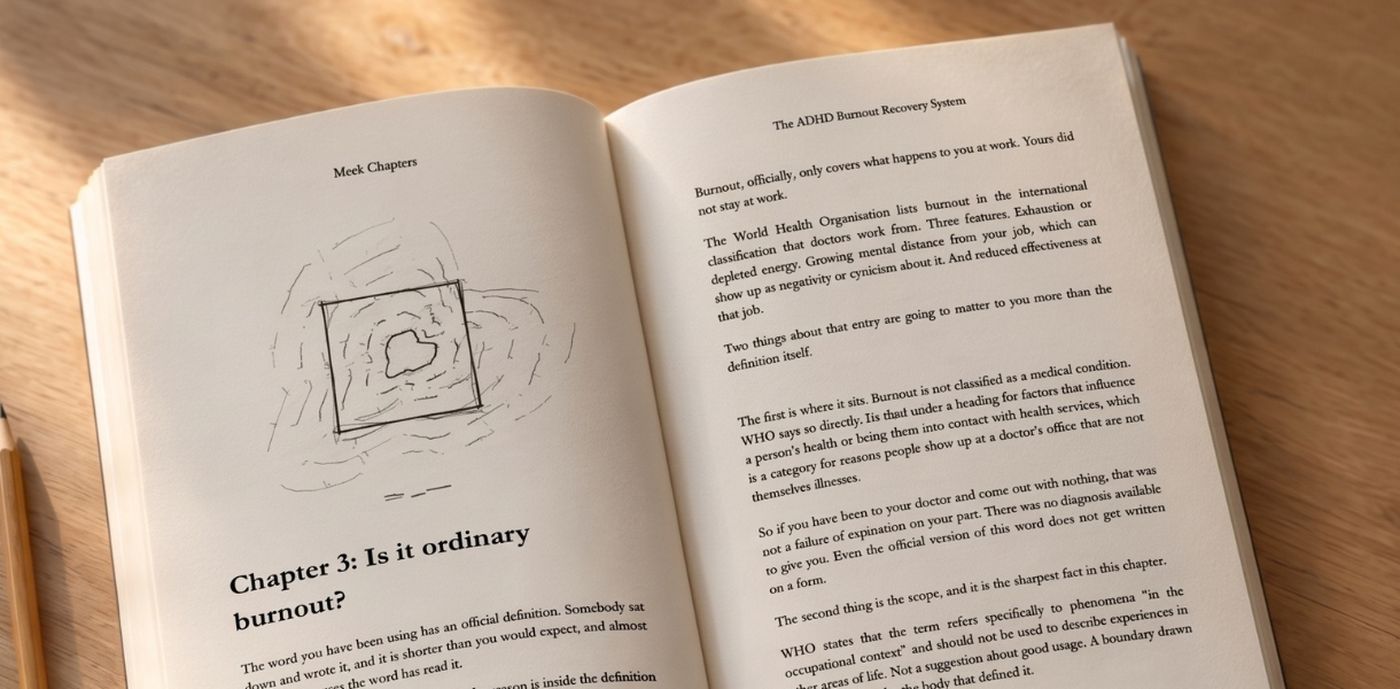
Every chapter opens on a hand-drawn plate.
4.4 out of 55 ratings on Amazon
A Practical Look at the Cost of Burnout
The ADHD Burnout Recovery System by Mark Chapters takes a detailed and refreshingly practical approach to a complicated subject. Viewing burnout in terms of cost rather than simply depleted energy was especially useful, since it helps explain why taking time off may not solve the underlying problem. I also appreciated the careful attention to distinguishing ADHD burnout from several similar conditions, along with clear guidance on when professional help is appropriate. Tools such as the Receipt and Thermostat make the concepts more concrete. The material can become fairly dense, particularly as the distinctions accumulate, but the precise writing and straightforward worksheets help. It is thoughtful, candid, and realistic about how long recovery takes.
For a complex and little understood area
The ADHD Burnout Recovery System treats this complicated condition as a multi-faceted and complex problem to be understood. The system is not a quick fix guide, but attempts to get to the roots of the problem in a non-judgmental way. I found the workbook elements to be the most helpful as the guided questions really helped me to consider various issues, and then using the free printable copies consider them again once I had read more of the book.
The writing style is very sparse and probably suits people who love direct advice.
Great Book for General ADHD Knowledge
What makes it stand out is how practical it is when medication alone hits a ceiling. The distinction between ADHD burnout and clinical depression is clear and validating, helping you stop fighting your brain with strategies meant for a totally different condition. The recovery steps are low-friction and realistic, designed for a mind that is already running on fumes.
This book gets to the heart of what ADHD burnout actually feels like—the chronic executive dysfunction, sensory overload, and emotional exhaustion that come from years of masking and pushing through.
educative
I have realized that there are so many things about myself I do not fully know of, and this book has brought a lot of awareness. We always think diagnosing ourselves can be a bit too far off, and stigmatized but I can relate to many of the problems stated here, I guess that speaks a lot. It was very enlightening and helpful in many ways.
Every instrument, as pages you can print again.
The complete kit, ten pages
All four instruments and the appointment sheet. Print the whole thing once, then reprint single sheets as you need them.
DownloadPDF, 392 KB Everything, in one fileInstrument 1, chapter 23, three pages
One line a day. The biggest thing you did, and what didn't happen after it.
The ruled sheet, a worked fortnight, the sort
DownloadPDF, 100 KB The ReceiptInstrument 2, chapter 24, three pages
A ceiling and a floor, set in advance and held regardless of how the day feels.
Setting the numbers, the week, the season, for the long one
DownloadPDF, 135 KB The ThermostatInstrument 3, chapter 25, one page
The sort, with the three questions printed on it so you don't have to remember them.
DownloadPDF, 128 KB Fake RestInstrument 4, chapter 26, one page
A list of things that cost almost nothing to be near, for the days when making the list is itself beyond you.
DownloadPDF, 93 KB The Pilot LightAlso in the kit, chapters 4, 7, 10 and 11, one page
What to walk in with, in the order to say it. Ten minutes runs on whatever you say first.
DownloadPDF, 141 KB Before the appointmentThese are free and they stay free. There is no email to hand over, no account to make, and nothing on this page is a sample of something else. If you only ever print one, print the Receipt.
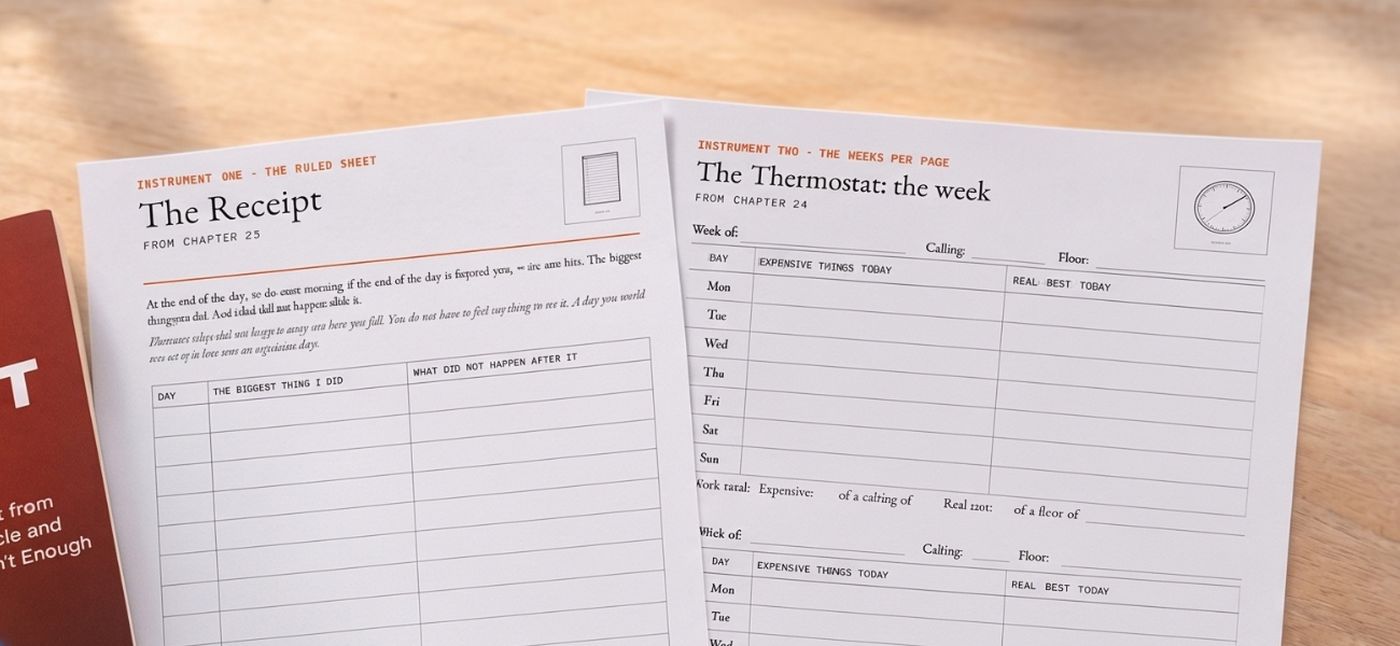
The kit, as it prints.
ADHD burnout is a collapse of capacity that outlasts rest, described by a very large number of adults with ADHD in almost identical terms. It is not a formal diagnosis. It is not in the DSM-5-TR or ICD-11, and almost no dedicated research exists on it. The one study that comes close, on twenty working adults with ADHD, found participants describing years of stressful work and repeated relapses of exhaustion.
Not necessarily, and nobody can separate the two cleanly, including the researchers who study them. A 2015 review called the distinction between burnout and depression conceptually fragile. If depression is a possibility for you, that alone is the reason to see a doctor, because depression is treatable. Only a professional can tell you which you are dealing with.
They drain different things. The ADHD pattern centers on executive load: starting things, switching, remembering, managing how you feel about a task while doing it. Autistic burnout centers on sensory and social load, and on the cost of masking. The recoveries pull against each other, because autistic burnout is helped by rest and reduced input while a large share of the ADHD side finds unstructured stillness makes things worse. Many late-diagnosed adults have both. If the autistic side sounds more like you, start there instead.
There is no established timeline, and anyone giving you a single number is guessing. Individual episodes can pass in weeks. The whole course, in the accounts this book draws on, runs in months and years, in two distinct shapes, and the book shows how to tell which one you are in. Some people cycle, recovering and collapsing again on a rhythm often tied to work. Others have one long episode with an acute phase and a much longer lingering phase that behave differently and need different things.
Because the problem is usually not how much energy you have left. It is what ordinary things cost you. Starting, switching, holding attention and managing how you feel all cost more for an ADHD nervous system, so an ordinary week runs over budget without anything going wrong. Rest refills the tank. It does not change the price of anything, which is why the relief lasts about as long as the time off.
Yes. Medication changes some of what a task takes from you and leaves other costs untouched. Attention and working memory get cheaper. Starting a long thing with no reward at the end of it moves less, and the social cost of masking does not move at all, because no medication masks for you. It also raises capacity without adding a rate limit, and capacity tends to get spent rather than saved. None of that is a reason to change what you take. It is a reason to tell your prescriber what improved, what never moved, and what changed about your workload since you started. The medicated, burnt-out reader gets a full chapter, When the meds are working and you're not.
The World Health Organization defines burnout as specifically occupational, and says the term should not be used for other areas of life. If what you have stayed at work, ordinary burnout may be exactly right. If it reached the shower, the friendships and the hobbies, and did not lift when you took time off, it is probably something else.
If you have stretches of elevated or irritable mood lasting several days with a reduced need for sleep, crashes that arrive a day or two after effort and are far out of proportion to it, or anything that feels like more than exhaustion. Several medical conditions produce exactly this picture, including thyroid problems, iron deficiency, low B12 or folate, sleep apnea and perimenopause. Most are ruled out with one blood test.
If you need help now. If things feel unsurvivable rather than exhausting, please talk to someone today rather than reading anything. US and Canada: call or text 988. UK & Ireland: Samaritans 116 123. Australia: Lifeline 13 11 14. Germany: TelefonSeelsorge 0800 111 0 111. Anywhere else: findahelpline.com.

Books for neurodivergent adults
Mark Chapters writes practical books for neurodivergent adults, made for the reader rather than written at or about them. He isn’t a doctor or a researcher. He’s the person in the middle, who reads the studies and the accounts people share in public, and says so where they disagree.
His books include The Autistic Burnout Recovery System, The ADHD Burnout Recovery System, Same Brain, New Map, Find Your Bottleneck, The Attachment Switch and The Neuro-Mechanic’s Guide to Home Maintenance.
Last reviewed 3 October 2026
4.458 ratings
If the drain is sensory and social rather than executive, and masking is the cost. Many late-diagnosed adults need both.
New, November 2026
If both are in the picture. Its chapter 12 sorts which side is paying.
The Autistic Burnout Recovery System. Each link opens Amazon in your country.
AuDHD, Honestly. Each link opens Amazon in your country.
Find Your Bottleneck. Each link opens Amazon in your country.
The ADHD Burnout Recovery System. Each link opens Amazon in your country.