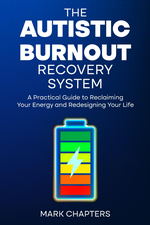
AutisticBurnout
Chronic exhaustion that sleep doesn’t fix. Skills you had last year, gone. A sensory threshold through the floor. It isn’t laziness and it isn’t depression — and resting alone won’t fix it, because rest is only one side of the ledger.
GET THE BOOK →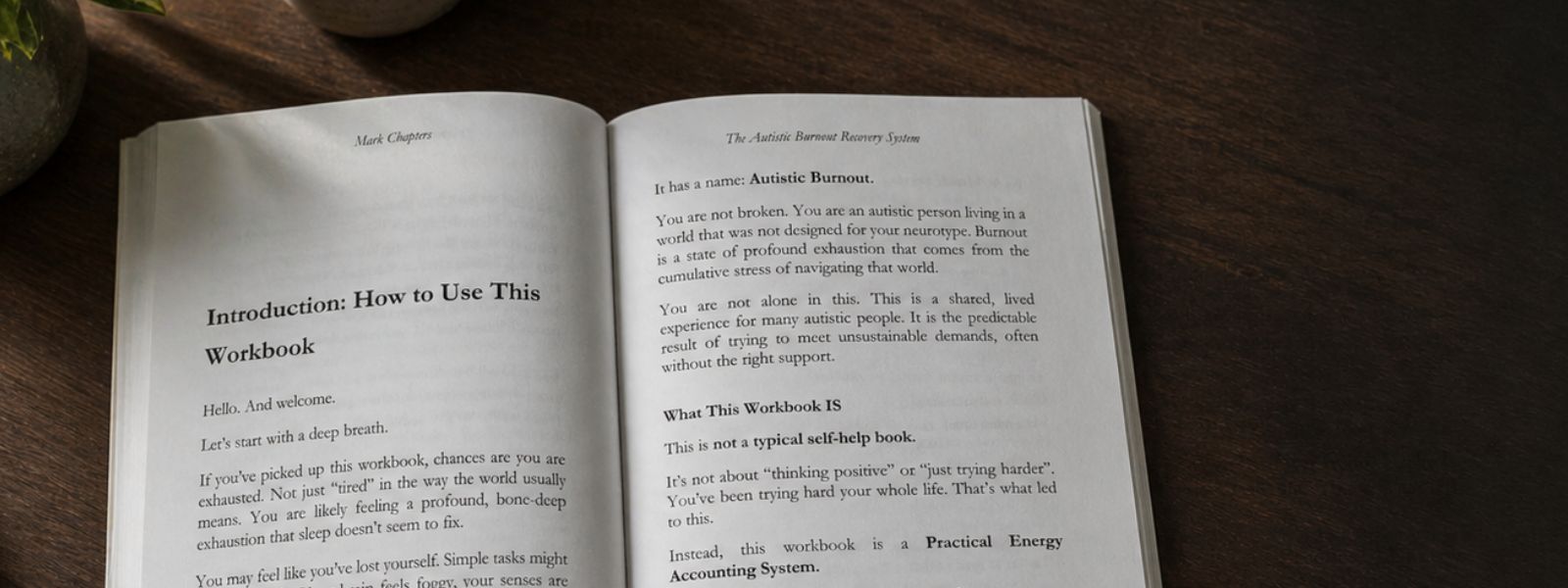
// 01 — IS THIS YOU?
You sleep nine hours and wake up tired.
Things you could do last year, you can’t do now.
The kitchen lights are suddenly too loud.
A message sits unanswered for four days.
Somebody asks a simple question and the words come slower.
You hold it together at work, then lose the rest of the day.
Small decisions — what to eat, what to reply — cost more than they used to.
You’ve been told you’re being dramatic.
A week off helped for four days.
You’ve stopped doing the thing you love most, and you can’t say why.
This has a name, and autistic adults named it themselves — years before the research caught up.
// 02 — WHAT AUTISTIC BURNOUT IS
Autistic burnout is a state of chronic exhaustion, loss of skills, and reduced tolerance to stimulus, caused by the cumulative demands of living in an environment that doesn’t fit. It was named and described by autistic adults long before researchers studied it. The first formal definition, published in 2020 by Dora Raymaker and colleagues, was built by asking autistic people directly — and found autistic burnout to be distinguishable from both workplace burnout and clinical depression.
Raymaker et al. (2020), “Having All of Your Internal Resources Exhausted Beyond Measure and Being Left with No Clean-Up Crew”: Defining Autistic Burnout. Autism in Adulthood 2(2), 132–143. doi.org/10.1089/aut.2019.0079
// 03 — THE BOOK
You are not broken and you are not depressed. You are overdrawn. Burnout is an energy debt — years of paying out more than came in, on an account nobody told you existed.
And the world’s price list doesn’t match yours. A ninety-minute meeting costs a colleague ninety minutes; it costs you the meeting, the hour afterwards to come back down, and the evening you’d set aside for the one thing that recharges you. Nobody is charging you wrongly. They are reading off a different list.
So this is a workbook, not a book. Short sections, checklists, no required order — written for someone reading in fog, at two in the morning, with the lamp turned down. And it says so on the page: you are not supposed to finish it. One page counts.
-
01
Triage & Stabilization
Stop the bleeding. Permission, validation, and the sensory-harm-reduction pass.
-
02
The Energy Accounting System
The core tool. Debits, credits, and your own ledger.
-
03
Rebuilding & Self-Advocacy
The words to say, decided on a calm day.
// 04 — THE LEDGER
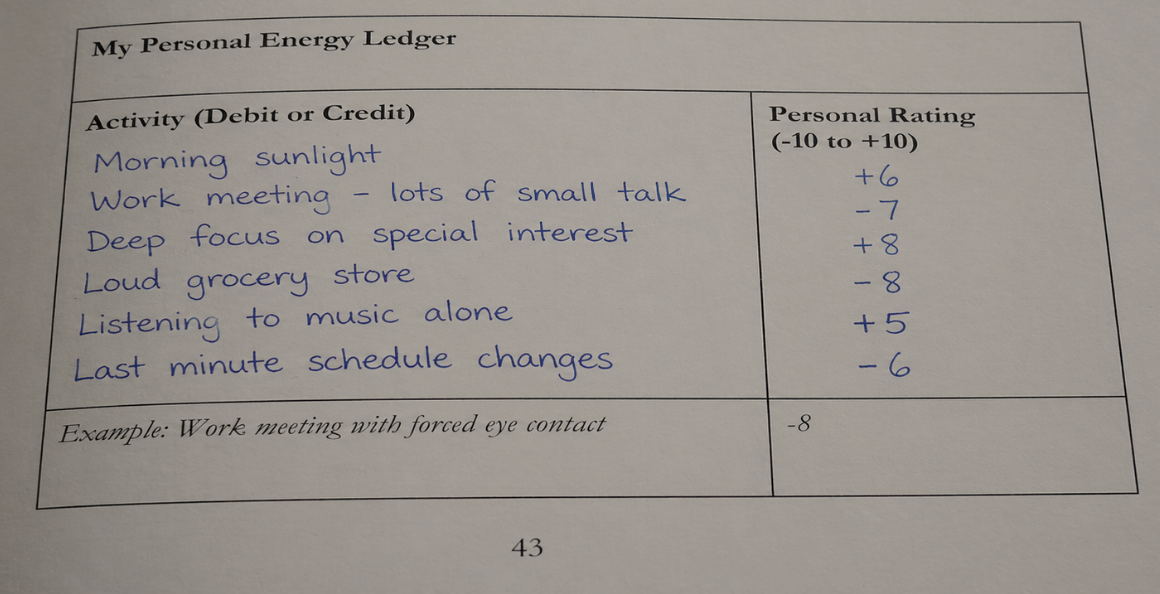
Once it’s on the page it stops being a character flaw and starts being a number. Numbers you can do something about.
// 05 — FORMATS
// 06 — READERS
Two readers of this manual. The rest are on Amazon, unedited — the critical ones included. Go and read those too.
“In this book you are given the validation of being seen and heard just as you are without labels like lazy or just not trying hard enough.”
THE AUTISTIC BURNOUT RECOVERY SYSTEM
“I like the energy accounting concept, which is precise and functional… I didn’t hope it to feel this useful and validating at the same time.”
THE AUTISTIC BURNOUT RECOVERY SYSTEM
// 07 — QUESTIONS
What is autistic burnout?
Autistic burnout is chronic exhaustion that rest doesn’t resolve, alongside a loss of skills you previously had and a drop in your tolerance for noise, light, and social contact. It builds from the cumulative cost of masking and coping in environments that don’t fit your wiring. Autistic adults described and named it years before it appeared in the research literature.
Is autistic burnout the same as depression?
No — the 2020 research found it distinguishable from clinical depression, though the two can occur together and one can lead to the other. The distinction people describe most often is that depression tends to affect how you feel about everything, including things you love, while autistic burnout tends to leave the wanting intact and take the capacity: you still want your special interest, you just can’t reach it. Only a professional can tell you which you’re dealing with.
How is it different from regular burnout?
Workplace burnout comes from a job, and changing the job usually helps. Autistic burnout comes from the accumulated cost of existing in a world calibrated for a different nervous system — which is why a holiday doesn’t fix it, because the environment is still there on Monday. The 2020 study found autistic burnout distinguishable from workplace burnout as well as from depression.
How long does autistic burnout last?
There is no established timeline, and anyone giving you a number is guessing. First-hand accounts range from weeks to months to years, with severe or repeated cycles generally taking longer. What the research does record is that people recover, and what they say helped them do it.
Why am I losing skills I used to have?
Loss of skills is one of the three defining characteristics of autistic burnout, and it’s the symptom people find most frightening — cooking, driving, following a conversation, sometimes speech. The framing that helps most is that those skills aren’t deleted, they’re offline: running them costs energy you don’t currently have, so your system stopped running them. That isn’t the same as gone.
What causes it?
Sustained overspending of energy — masking, sensory load, social decoding, task-switching, and the constant cost of adapting — without enough coming back in. The workbook treats this as an accounting problem rather than a character problem: your outgoings have exceeded your income for a long time, on an account nobody told you existed. It’s especially common in people diagnosed late or not at all, because a lifetime of successful masking is a lifetime of an invisible expense.
Is there a test or a quiz for autistic burnout?
There’s no validated diagnostic quiz, and autistic burnout isn’t a formal diagnosis in the DSM — though researchers have begun work on measuring it properly. What helps more than a quiz is a symptom review and an honest energy audit over a week or two. The workbook contains both; a professional can help you rule out other explanations.
What actually helps?
When researchers asked autistic adults what helped them recover, three things came back: acceptance and social support, time off with genuinely reduced expectations, and doing things in an autistic way — including unmasking. The order of operations matters more than the tactics: reduce what you’re spending before you try to add rest, because rest is income and income alone can’t clear an overdraft.
I can’t cope at work. What now?
Nobody on the internet can tell you whether to quit, take leave, or ask for adjustments — that depends on your contract, your country, and your circumstances. What is solvable in advance is the smaller problem hiding inside it: knowing you need a boundary and knowing the words to say are two different skills, and the second one can be decided on a calm day and kept where you can reach it. The workbook’s third part is a set of those scripts.
If things feel unsurvivable rather than exhausting, please talk to someone today rather than reading anything. US: call or text 988. UK & Ireland: Samaritans 116 123. Australia: Lifeline 13 11 14. Germany: TelefonSeelsorge 0800 111 0 111. Anywhere else: findahelpline.com
// 08 — WHO WROTE THIS + THE SERIES

One mechanism each. The premise throughout: you are running neurotypical software on neurodivergent hardware, and every manual repairs one specific system failure. This one is the engine. Take whichever matches what is still stuck.